 Gerrit Code Review
Design Doc - Code Search for Gerrit - Solution: Zoekt-based Search Platform
Solution: Zoekt-based Search Platform
Overview
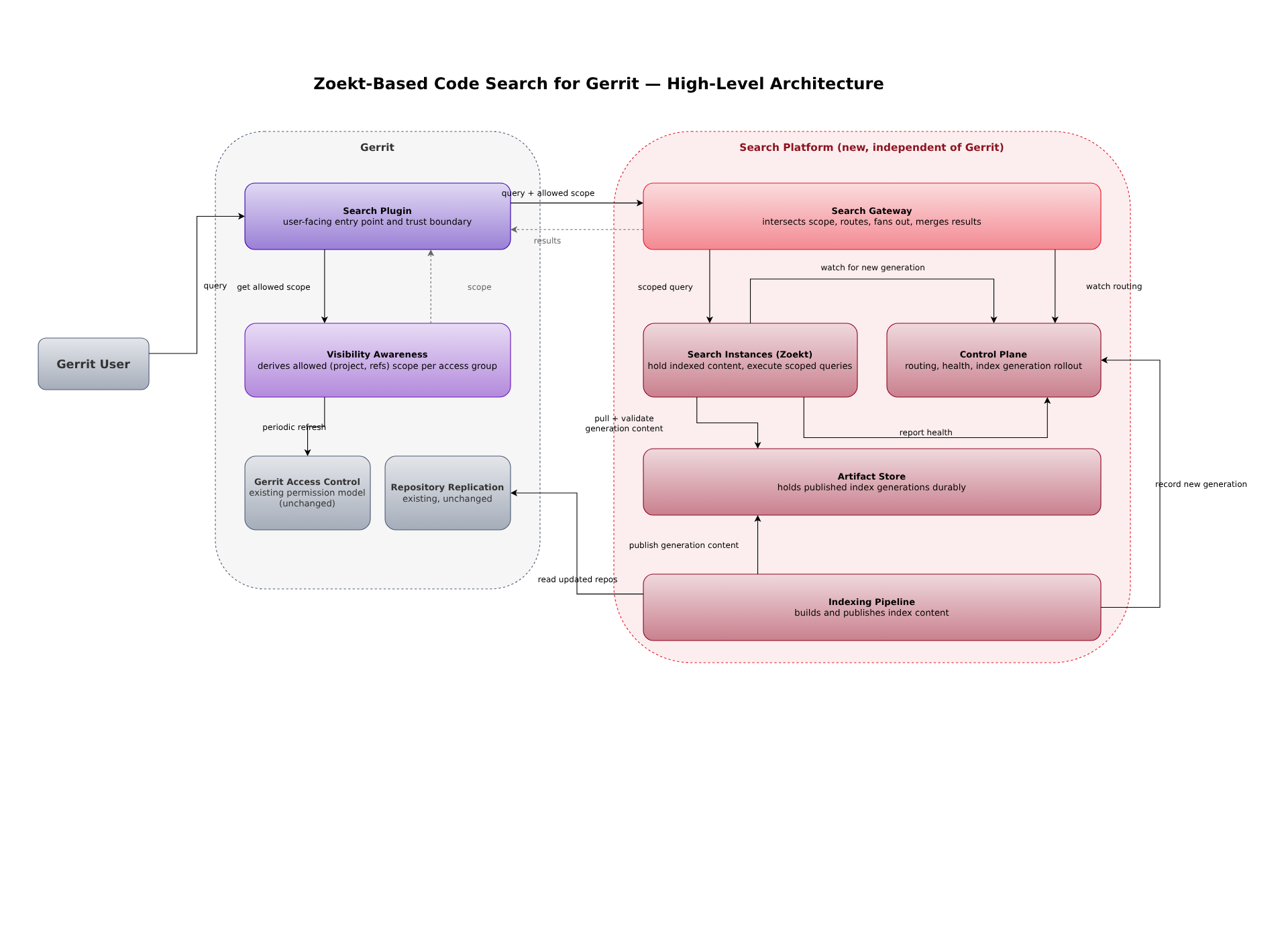
Gerrit remains the identity and trust boundary for every search request. A logged-in user’s query flows from Gerrit’s own UI, through a Gerrit-side component that knows the user and their allowed scope, to a separate search platform built around stock Zoekt. The search platform is only ever told a query together with the scope it’s allowed to touch.
The search platform adds the pieces that stock Zoekt does not provide on its own: a scoped gateway in front of multiple Zoekt webservers, repository ID management, index generation publishing, per-node shard activation, and a control plane for routing and node health.
The full step-by-step walkthrough, for both the query path and the indexing path, is in End-to-End Flow below.
Components
The design is built from a small number of responsibilities, split across two independent systems: one on the Gerrit side, one forming a standalone search platform.
On the Gerrit side:
- Search plugin — the only user-facing entry point and trust boundary.
Requires a logged-in Gerrit user, resolves their identity through
whichever authentication method the deployment already uses, attaches
that user’s allowed scope, and returns results through Gerrit’s UI and
REST API. Each result links to the repository browser configured for the
deployment: Gitiles is the primary integration, while a configured
config-gitwebURL can be used when Gitweb is the site’s browser instead. If neither browser integration is available, search still works but the result cannot provide a file-view link. Also exposes, for the same allowed scope, which of the user’s readable projects and branches are currently indexed. - Visibility awareness — continuously derives, from Gerrit’s real access control rules and the currently indexed project/ref coverage, which projects and refs each group of users can read, and keeps that answer ready so most search requests do not have to wait on it. A bounded on-demand computation handles a group that has not yet been seen. The plugin can keep both a group-level visibility cache and an account-level cache of the effective scope for recently active users.
- Index coverage configuration — records which projects and branches should be indexed. This can start as an administrator-owned configuration and later expose project-owner controls if a deployment wants delegated management.
In the search platform (independent of Gerrit, reusable by any caller that can supply a valid scope):
- Search gateway — the entry point for scoped queries and coverage
requests. It accepts requests only from authenticated, deployment-
authorized service callers (for example, the Gerrit plugin using
mTLS/service identity or an equivalent short-lived service credential),
and rejects unauthenticated or unregistered callers before processing the
request. This caller authentication is separate from end-user
authorization: the gateway does not trust the caller merely because it
supplies a scope. It translates the caller-supplied
{server, project, refs}scope into Zoekt repository IDs and branches, ANDs that scope into the parsed Zoekt query, routes to the right shard groups, fans out to one healthy replica per touched group, and merges ranked results. Empty, missing, or fully unresolved scope returns zero results with scrubbed statistics. - Zoekt webservers — stock Zoekt instances that hold
.zoektshards and execute the actual search. The design does not require forking Zoekt; scope is enforced by adding aBranchesReposconstraint to each query before it reaches Zoekt. - Indexer — obtains stable non-zero repository IDs from the control plane, stamps them into repositories before indexing, invokes Zoekt’s normal git indexer, and publishes the resulting shards as immutable generations.
- Sync agents — run next to Zoekt webservers, fetch the newest generation for the node’s shard group from the artifact store, validate shards locally, and atomically rename them into the directory watched by Zoekt.
- Artifact store — holds published index generations durably, so nodes can fetch a generation independently of the indexing pipeline that produced it.
- Control plane — owns repository ID allocation, routing snapshots, and node health. It can be backed by a consistent store and exposed through a small stateless broker API.
This split is deliberate: the search platform never needs to understand Gerrit’s users, sessions, or access rules. All Gerrit-specific knowledge stays on the Gerrit side.
End-to-End Flow
Query flow — a user searches:
- A logged-in Gerrit user submits a query through Gerrit’s own UI or REST API.
- The search plugin resolves the user’s identity and asks visibility awareness for that user’s currently known allowed scope — normally an already-computed answer, occasionally a short, bounded wait if this is the first time that user’s group has ever been asked.
- The search plugin forwards the query together with the allowed scope to the search gateway. The scope always travels separately from the query text, so a user’s own query can never be used to widen it.
- The search gateway resolves project names to repository IDs,
converts refs to branch labels, builds a Zoekt
BranchesReposscope, and combines that scope with the parsed user query. - The gateway uses its cached control-plane routing snapshot to choose one healthy Zoekt replica for each touched shard group, sends concurrent requests, and treats an unavailable shard group as incomplete rather than widening scope or failing open.
- Each Zoekt webserver evaluates the query only against the content named by the scope constraint, and returns its matches.
- The search gateway merges, ranks, and returns the combined results to the search plugin, which renders them back to the user.
Three outcomes are always distinguished: normal results; “no results” (covering both a genuinely empty match and a user with no readable scope — deliberately indistinguishable, so a lack of access can never be inferred from the response); and “search unavailable” (the search platform itself could not be reached), so an outage is visible rather than mistaken for an empty result.
Coverage flow — a user checks what’s indexed:
- A logged-in Gerrit user asks the search plugin which of their readable projects/branches are indexed. For large result sets, the request can include pagination and filters over project or branch names.
- The search plugin asks visibility awareness for the user’s allowed scope, the same way it does for a search query.
- The search plugin asks the search gateway for indexed coverage and returns the intersection of that coverage and the user’s allowed scope — never revealing coverage for a project/branch outside the user’s allowed scope.
The same indexed/not-indexed status can be shown from repository and branch views by asking for coverage only for the project/branch rows the caller is already allowed to see.
Indexing flow — keeping the index current:
- A deployment supplies the repositories and refs that should be indexed, according to its configured coverage policy (see Branch Policy). The source repositories may come from Gerrit’s normal replication or another local mirror maintained by the site.
- The indexer asks the control plane for the stable non-zero repository ID for each project, stamps that ID into the repository metadata consumed by Zoekt, and runs Zoekt’s normal git indexer for the configured refs.
- Newly built shards are grouped by shard partition and published to the artifact store as immutable generation directories.
- A sync agent next to each Zoekt webserver polls or watches for the newest generation for its partition, downloads those shards to local disk, validates them, and atomically renames them into the webserver’s watched directory. Publish and activation are deliberately separate: the indexer never writes directly into a serving node.
- The control plane records repository IDs, routing, and live nodes. Gateway instances consume this as cached snapshots.
Branch Policy
Which projects and branches get indexed and access-checked is a deployment decision, not a fixed requirement of this design. A deployment can start by indexing only default branches for selected projects and expand from there — to a broader active-branch set, to specific long-lived branches, or further — once it has measured the actual demand, storage cost, and access-check cost of doing so for its own repositories. Nothing in this design requires starting anywhere other than the smallest option.
Coverage configuration should be treated as data consumed by the indexing pipeline and control plane, not as code baked into either service. That lets administrators or project owners change indexed coverage without rebuilding the search platform.
Repository IDs are part of that managed data. IDs must be stable, non-zero, and never reused for another project; otherwise a query scoped to one project could accidentally match shards for another project. The control plane should be the single authority that allocates and persists IDs, and the indexer should fail closed if it cannot obtain a valid ID.
Scalability
Indexed content and query load are spread across many serving nodes, and that fleet can grow, shrink, or be rebalanced independently of the Gerrit-side components — a busier search platform does not require touching Gerrit, and vice versa.
The gateway routes by repository ID to shard groups and sends each query only to groups that can contain in-scope repositories. Each shard group can have multiple replicas; the gateway chooses a healthy replica from its cached routing snapshot and marks results incomplete if a needed group has no live replica. This preserves correctness under partial failure: missing capacity can hide matches temporarily, but it cannot add out-of-scope matches.
The index rollout path is eventually consistent by design. New generations are published once, then sync agents activate them independently on each serving node. This avoids a coordinated fleet-wide restart and lets a node keep serving its previous validated shards if it cannot fetch or validate a new generation.
The visibility-awareness component scales with the number of Gerrit access groups and projects, not with the number of users or the rate of search requests, since it computes and caches an answer per group rather than per user or per request.
The largest scale risk for any given deployment is how many branches it chooses to index — a large or unevenly distributed branch count drives indexing, storage, and access-derivation cost independently of query volume, which is why branch coverage is treated as a deployment policy decision to be measured, not a fixed default (see Branch Policy).
Visibility-derivation cost and refresh interval must be tuned per deployment: measure the cost of deriving allowed scope from Gerrit’s access rules, and tune how often it is refreshed against that measurement, rather than assuming one interval fits every installation. A new or previously unseen account/group adds a bounded, synchronous derivation cost to its first query — trading a slower first request for not returning empty results to a new user — and that timeout should be tuned per deployment as well.
The control plane should also be kept off the per-query hot path. Gateways should watch routing and repository-ID snapshots and serve from memory. Losing the control plane temporarily makes those snapshots stale; it should not fail every query.
Alternatives Considered
Use OpenGrok as the search backend
OpenGrok indexes and authorizes at project granularity, not per branch or
ref, so it has no native way to represent Gerrit’s ref-level access model.
Giving OpenGrok branch-awareness means synthesizing it externally — for
example a separate working-tree checkout and index per branch, or a
project+branch sharding scheme — with cost that scales with branch count,
not just project count. A quick test of the Gerrit project’s 52 branches
showed the difference concretely: a single Zoekt index covering all 52
branches was about 1.1 GB and took about 40 seconds to build, tagging each
result with the branches that contain it and supporting branch:<name>
query filtering natively; covering the same branches in OpenGrok required
a full working-tree checkout per branch, about 407 MB each. OpenGrok’s
genuine strength is its code browser (cross-references, jump-to-definition,
annotate, history), but Gitiles already renders files, blame, and history
while enforcing Gerrit’s ACLs natively, so this design uses Zoekt for
search and links results out to Gitiles for browsing instead of adopting
or ACL-wrapping a second browser. Zoekt is also licensed Apache 2.0, the
same as Gerrit, versus OpenGrok’s CDDL.
Expose the underlying search engine directly to users
Simpler to deploy, but rejected outright: a general-purpose search engine has no concept of Gerrit sessions or access rules, so exposing it directly would mean either no access control on search results, or duplicating Gerrit’s access model inside a system that was never designed to hold it.
Have the search platform enforce Gerrit’s access rules itself
Would require the search platform to understand Gerrit’s permission model in depth, risking the two implementations drifting apart over time, and tightly coupling a platform that should be able to serve any caller to one specific host application’s security model. Keeping all access-control knowledge on the Gerrit side, and having the search platform simply enforce whatever scope it’s handed, keeps the two systems cleanly separated.
Fork Zoekt to add Gerrit-specific authorization
Would put Gerrit-specific concepts into the search engine and make future Zoekt upgrades harder. Stock Zoekt already has the query-level primitives needed to constrain searches by repository ID and branch, so the safer integration point is a gateway that constructs scoped Zoekt queries before fan-out.
Check every result against Gerrit after search
Would reduce the risk of stale visibility data, but it would also make search latency and load proportional to result count and Gerrit’s live permission-check cost. It also does not prevent leaking aggregate information unless the search platform still avoids exposing raw match counts before filtering. The proposed design filters before search and accepts a documented, bounded staleness window for access changes.
Off-the-shelf commercial or hosted code search products
Worth evaluating independently on their own merits (Gerrit integration, access-control parity, scale, operational fit), but out of scope for this design, which assumes building and operating the search platform in-house.
Pros and Cons
Pros:
- Because the search platform’s gateway only ever consumes a caller-supplied scope, it is not limited to serving the Gerrit plugin — any future caller that can supply a valid scope could reuse the same platform without new Gerrit-specific work on the search platform side.
- The gateway can be extended to route to other code-search provider nodes, not only Zoekt webservers, as long as the provider can enforce an explicit project/ref scope before returning results.
- The search platform uses stock Zoekt webservers and Zoekt’s normal indexing path, so it avoids maintaining a Gerrit-specific fork of the search engine.
- Gerrit and the search platform can each be upgraded, scaled, or rolled back on their own schedule, without coordinating a joint release.
Cons:
- Debugging a bad result is harder than with a single embedded system: a wrong or missing result could stem from a stale visibility scope, a gateway routing issue, or an indexing problem, and diagnosing it means correlating state across two independently operated systems.
- Every query takes on an extra network hop (plugin to gateway to Zoekt webservers) that a search engine embedded directly in Gerrit would not have.
- Repository ID allocation becomes correctness-critical. The system must guarantee stable, non-zero, non-reused IDs before indexing.
Implementation Plan
- Land this design.
- Build the Gerrit-side search plugin and visibility-awareness component.
- Build the search gateway against stock Zoekt webservers, including scoped query construction, shard-group fan-out, result merging, and scrubbed empty-scope behavior.
- Build the indexer, artifact-store publication, and per-node sync-agent activation path.
- Build the control plane for repository ID allocation, routing snapshots, and node health, keeping it off the query hot path.
- Validate against a subset of real repositories.
- Roll out search starting with default-branch coverage.
- Measure real branch activity, indexing cost, and access-derivation cost, and expand branch coverage per Branch Policy based on those measurements.
Time Estimation
Rough implementation phases:
- Gerrit plugin, search UI/API, and visibility caching: 4-6 weeks.
- Scoped gateway, Zoekt fan-out, result merge, and coverage API: 3-5 weeks.
- Indexer, artifact publication, and per-node sync agents: 3-5 weeks.
- Control plane, repository ID allocation, routing snapshots, and node health: 4-6 weeks.
- Production hardening, rollout automation, metrics, and staged deployment: 4-8 weeks.